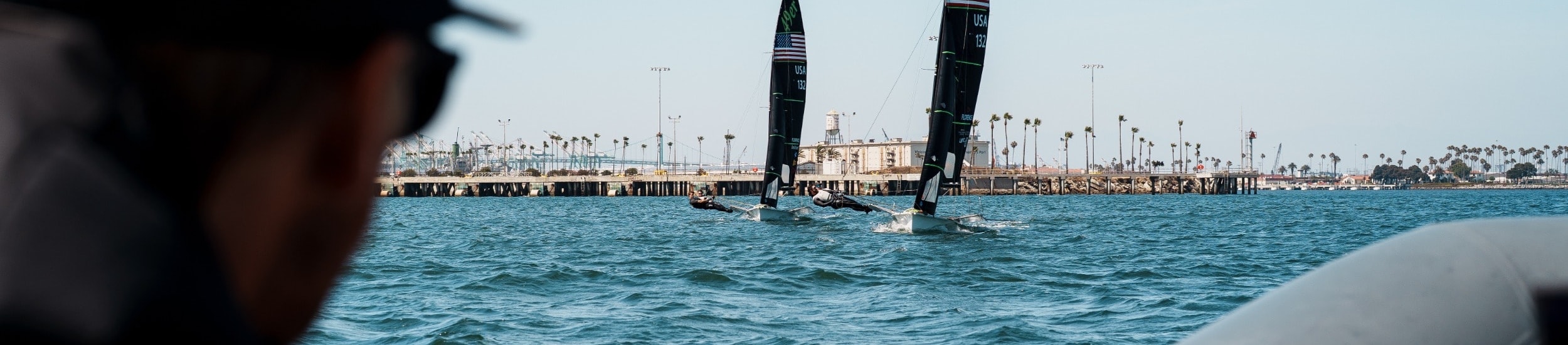
For Janov Racing, the next regatta is more than another event on the calendar. It is a line between two phases of our campaign.
We have spent the past year focused on speed: learning the boat, testing settings, training against strong international teams, and building a faster, more reliable platform across a wider range of conditions. Now, on the waters that will host the Los Angeles 2028 Olympic sailing competition, we are preparing to find out how much of that work survives the pressure of an actual race.
We recently wrapped up another training block in Long Beach, with our Swedish training partners before moving to San Pedro for the Olympic Classes Regatta. The event will bring the international fleet together for the first time on Olympic waters in San Pedro and give American sailors a rare opportunity to race in a competitive fleet close to home.
The fleets may not be large, but that does not make them soft.
Because leading sailing federations can send only one or two teams, the boats that do arrive tend to be among their best. The result is a compact fleet with very little empty space in the standings. There may be fewer competitors on the starting line, but the depth of the competition makes every mistake expensive.
That is exactly what makes the event useful for us.
The regatta will be the final benchmark at the end of our year of speed and the first step into our year of racing. It is a chance to take everything we have learned about straight-line performance and put it into a setting where speed is only valuable if it creates a tactical advantage.
Training can tell us whether we are fast in a lineup. Racing asks a harder question: can our speed produce a good start, hold a lane, survive traffic, and deliver us to the first mark in a position from which we can attack?
In San Pedro, that question may become especially clear.
The racecourse often rewards a fairly direct route toward the right side. When the course becomes one-track, there are fewer opportunities to escape through a clever split or recover with a dramatic tactical move. The first beat can become a drag race, and the boats that are unable to hold their lanes get exposed quickly.
For us, that makes the first weather-mark rounding one of the most important measurements of the week.
If we can consistently reach the first mark inside the top five or top ten, it will be evidence that our investment in speed is beginning to pay off. It will not answer every question about race execution - the focus for next season - but it will show that we can come off the line, sail the favored track, and arrive at the first major decision point in contact with the leaders.
That is a more meaningful test than simply comparing a few isolated moments of boatspeed. It measures whether the whole package works together: preparation, starting, lane management, technique, communication, and speed under pressure.
It also marks a change in how we will think about improvement.
During the year of speed, the central questions were about making the boat go faster. Which setup creates the right balance? Which techniques work in a particular sea state? How do we convert two-boat testing into a wider and more dependable performance range?
The year of racing adds another layer. Now the questions become: Where should that speed be used? How do we use it tactically? How quickly can we recognize the racecourse pattern, execute the first beat, and turn a fast boat into a strong result?
The shift does not mean the speed work is finished. Olympic campaigns rarely move from one skill to another in a perfectly clean sequence. Boat speed still needs to be maintained, refined, and adapted. But the emphasis changes. Instead of treating speed as the final product, we begin treating it as a tool for racing.
There is something fitting about making that transition in Long Beach and San Pedro. These are our home waters, but they are also Olympic waters. Every training day builds local knowledge. Every international regatta offers a preview of the level and style of racing we are ultimately preparing to meet.
For now, the benchmark is straightforward: get off the line, hold the drag race, and arrive at the first weather mark with the front group.
The year of speed was about building the weapon. The year of racing begins with learning how to use it.