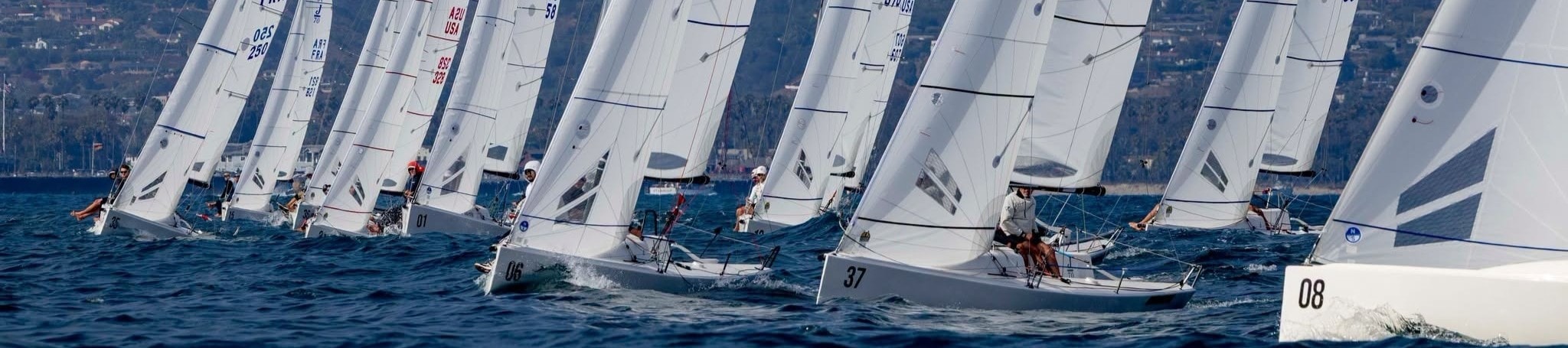
We finished fourth at the J/70 Nationals in Santa Barbara earlier this month. Not bad for a team that hadn't sailed together in that configuration before, with our dad driving and only six days of lead-up. The hardest part with a new team: starting. We were second row off the line in most races, and found ourselves digging back in the fleet. Spending so much time in the middle of the fleet sharpened our ability to read the minds of the boats around us, anticipate their next move, and see where the right lane would open before it was obvious.
Our worst result was a seventh. Our best recoveries came from starting in twelfth or fourteenth and rounding the top mark in third or fourth. That happened five out of seven races. The concept wasn't new; the value was getting to practice it so many times in one week. By the end of the regatta, we felt confident not only about where to tack, but about why that lane would still be available when we got there.
The Problem: Second Row on a One-Sided Course
Santa Barbara is generally a right-hand racetrack. When you get off the line in second row and it's a drag race to one side, things can unravel fast.
"When you have a bad start, and it's a drag race out to one side, it can be really challenging to keep up with the top group. It is very easy to just get pushed back and back and back," Jordan explains.
We watched a lot of good sailors—teams we respect—get pushed into the twenties after falling into this situation. The instinct when you're behind is to find clear air: sail to the open lane, get your bow out, and try to come back. But on a course where one side is heavily favored, that instinct can cost you the race.
What We Practiced: The Lane You Deserve
On our team, we often talk about a concept called the "Lane You Deserve," or the "Wadlow Lane," named after 49er sailor Tim Wadlow. The idea is simple but counterintuitive: when you're behind, you're not looking for a clear-air lane. You're looking for a lane you can barely survive in—one that's slightly compromised but doesn't cost you extra meters or push you over the layline. Santa Barbara gave us a clear example and enough repetitions to execute the idea with real confidence.
"You're already second row. There is no perfectly clear air anymore, anywhere, for you. You messed up the start, you don't deserve clear air. The guys who won the boat end deserve clear air," Jordan explains.
Here's what it looked like in practice: we'd come out of the corner in thirteenth and tack around 68%—just under 70% of the way to the layline. The boats ahead of us would look at our lane and think, I don't really want to tack there, but it's close. When you're in tune with what tacticians on the boats around you are thinking, you can find the lane just before any of them are interested in tacking, to get across in. We'd become one of the few boats on starboard still able to sail fast—not covered, and not pushed past the layline.
"By the time you get to 90% to layline, you're in fourth. And then all those guys are struggling on the layline - you can sneak in right at the end, and you're like, man, we just picked off 10 boats!"
The key is that staying in the battle matters more than finding perfect air. A B+ lane that keeps you in the fight beats an A+ lane that takes you out of phase or away from the favored side. The skill is reading the minds of the boats around you—anticipating which lanes they will reject, where they will tack, and what space will still be open one move later.
How to Apply It
Here's what the week reinforced for us—and what you can use at your next regatta:
Accept your situation immediately. Second row means no clear air. Stop looking for it. Start thinking about position relative to the favored side.
Count the boats going to the favored side. Every boat you let cross or duck to that side will likely pass you. Get on the favored tack as quickly as you can, even if the lane is tight.
Take the B-plus lane. Look for a lane where you have to work hard but can just barely make it. Not Plan C (compromised bad air), but Plan B—where effort keeps you alive.
Upgrade after the fleet settles. About a minute off the line, teams with speed issues fall out of their lanes. Take two quick tacks—30 seconds on the opposite tack—and upgrade your position while staying on the correct side of the course.
Tack at 68%, not 110%. When you're behind, the temptation is to push to the corner and hope. Resist it. Tack shy of the layline. Be the first boat out of the corner, not the farthest boat in.
Let the leaders overstand. When you tack at 68% and they try to call a perfect layline from a mile out it's amazing how often you'll converge at the mark, and you'll have the inside position.
The Bigger Lesson
This regatta was part of our transition into Year Three of our Olympic campaign—the year of racing. We're targeting 30 regattas next year, and the J/70 Nationals was an opportunity to start transitioning back into the racing mindset. Working with our coach Dave Ullman and Patrick Wilson, who won the J/70 Worlds in 2018, gave us the repetitions we needed to make a familiar concept feel automatic. By the end of the week, we were choosing our tack point with much more confidence because we could anticipate how the boats around us would play the next move.
So much of sailing is about reading the minds of the boats around you and playing the game one step ahead. The lane you deserve isn't necessarily the one you want. It's the one you know will keep you in the race.